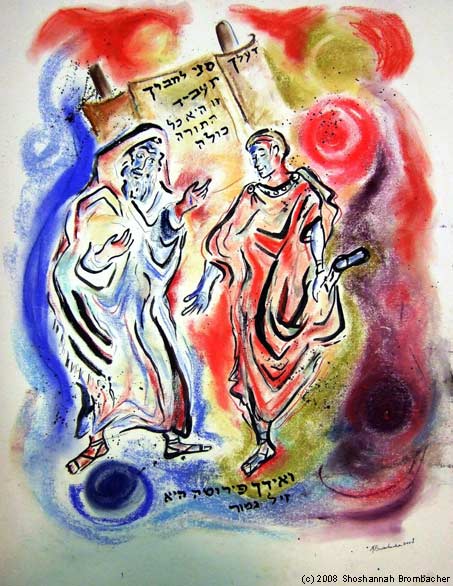
 There is a grand debate about which really is the most
important principle in the Torah. Most people know the famous story about the
convert who came to Hillel and asked to be converted on the condition that he
is taught the whole Torah on one foot. Hillel is nonplussed by the seemingly
bold request and answers that a person should not do what is hateful to him to
another person, that is the entire Torah and rest is just details, now go
learn. He understood the covert was
genuine and simply wanted a framework with which to build his knowledge. However,
there is a slight problem with the conventional understanding of this story. It seems the only idea that he teaches the
potential convert is that the foundation of Torah is how we treat others, but
that may not be the whole picture.
There is a grand debate about which really is the most
important principle in the Torah. Most people know the famous story about the
convert who came to Hillel and asked to be converted on the condition that he
is taught the whole Torah on one foot. Hillel is nonplussed by the seemingly
bold request and answers that a person should not do what is hateful to him to
another person, that is the entire Torah and rest is just details, now go
learn. He understood the covert was
genuine and simply wanted a framework with which to build his knowledge. However,
there is a slight problem with the conventional understanding of this story. It seems the only idea that he teaches the
potential convert is that the foundation of Torah is how we treat others, but
that may not be the whole picture.
The Talmud
in Makkos deliberates about what are the foundational mitzvoth in the Torah. If we had to distill 613 mitzvoth to a small
number of mitzvoth that represent the others, what would they be? The Talmud
concludes that all mitzvoth could be distilled to a verse in the prophet
Habakuk: “ A righteous person in his faithulness he shall live”. Meaning, that all mitzvoth boil down to
faith. We are now left with a question,
is the main foundation of Torah faith or how to relate to others?
The question
is a straw man because it is based on a flaw in the way we read Hillel’s
statement to the convert. The reality is
that the verse that Hillel’s idea is based on has an ending that is often left
off. The full verse is, “Do not bear a grudge or take revenge, and love your
neighbor as yourself, I am Hashem.” Therefore, if we understand that Hillel’s
communication to the convert is the whole idea of that verse, it includes the
idea at the end- “I am Hashem”, which is the foundation of all faith- there is
a G-d. Now, Hillel’s statement incorporates both foundations. The Torah is
based on having a healthy relationship with others in addition to a healthy
relationship with G-d. This makes sense
if we look at the Ten Commandments that are also divided in this fashion, on
two tablets, one dedicated to establish a relationship with G-d and another to
establish a relationship with man. It
could also be that not only are these two principles the foundation, but it
could also be that they are inextricably linked in that the key to success in our
relationships with others is to understand that there is a G-d from which we all
descend.

No comments:
Post a Comment