Friday, February 1, 2019

Grooming leaders


Image result for hiding behind phone                People rue electronic devices for many reasons.  Primarily, though, the focus of the criticism is the lack of focus that these devices produce.  The beeps and subsequent dopamine rushes are hard to overcome. Often, phantom vibrations and incessant phone checks ensue.  This week’s parsha highlights a bigger problem with technology.  It is hard to get close to people today.  Even the sound of a live voice is considered too close as we resort to texting and emailing as our primary mode of communication and this may be hampering our development in a different way.

                In today’s parsha we are introduced to Joshua.  What is interesting is how he is described- he is Moshe’s servant, not student. The midrash elaborates that he served Moses by setting up his classroom with benches and mats where people could sit. Something that today would be relegated to a janitorial role. At the end of the parsha, as we flip back to Moses’ preparation to ascend Mt. Sinai, it says that Joshua followed him as far as he could go and then bids adieu to his mentor.  One might think that after seeing his Rabbi off that he would now go home. But, no, he pitches a tent and encamps for 40 days until Moshe returns lest he be a moment without his helper. Today we would describe Joshua as a nudnik, not loyal.  Nonetheless, it is Joshua who will become the next leader because as the Talmud corroborates it is better to serve a teacher than merely learn from him. Why? 

                There are three ideas that we need to highlight.  The simple understanding is that service breeds humility.  When it comes to learning and growth that is the character trait we need in abundance for it allows us to see reality as it is rather than confirm the reality we want.  The second idea is that for a new wick to burn it needs to get close to the flame.  A proper mentor has a vibrancy that needs to be felt in order to grow to the next level.  Finally, a relationship always needs to be a two way street. If a mentor gives wisdom, a student needs to give back care.  This creates a true bond between teacher and student with which more and more transmission can take place.  These lessons are crucial to produce the next generation of leaders.   

Saturday, November 24, 2018

Down but not out


Our beginning was not simple.  Upon our creation, the angels immediately lobbied against this idea.  They claimed, correctly, that man would fail and forget about their Source. Was it really worth it to create such a fallible creature that would drag the world through the mud? Why not keep the world angelic?  

Then, at the vision of the ladder, one Midrash claims that the angels were hovering around Yaakov like flies until G-d sends them away. This tension then comes to a head with a wrestling match between Yaakov and angel, some say it is the same original angel that talked against man, and is then cemented into our current name- Israel- wrestling with the angelic. What is the nature of this tension of human and angel and what does this tell us about who we are?

                The world angel doesn’t capture the essence of what these beings represent in Torah. The word angel means ‘messenger’.  They are created for a particular mission and they carry it out perfectly but that is it.  After the mission is over, they disappear. They have no essence that remains outside of its mission. In contrast, man can wallow about doing nothing; yet, he maintains an identity. His identity doesn’t depend on his accomplishment.  He is defined by his struggle and even in the moments of deepest despair, he still has a spark that can reignite at any second.  Angel and man are two diametrically opposed creations. One is mission dependent and one exists despite mission failure. The greatness of a being that exists independently of mission accomplishment is that it can regenerate even after failures. An angel doesn’t understand failure while we realize that we are defined by them.

Friday, November 2, 2018

Planting our dead

Image result for machpelah burying sarah
In a sad and ironic twist of fate, the timing of the Pittsburgh shooting is similar to the synagogue massacre that took place in Jerusalem 4 years ago during the Torah portion that deals with burying one’s dead.  Although no less a tragedy, the Torah portion provides the blue print for comfort when it comes to death. There are strange themes and elements in the parsha that dictate to us how we should view death and burial.

                First, the people whose plot of land he buys is children of Chet- translated literally as the children of the letter ‘chet’.  Their name appears ten times in this small segment of text.  The person in charge of the cave is named Ephorn, whose name is ‘afar’- dirt.  He then buys a cave called the cave of doubling.   Not surprisingly, the letter Chet in Hebrew is the only one made of doubling two other letters- zayin.  What is the Torah trying to communicate?  Further, when it describes that Avaraham cries, the letter ‘caf’ of the word ‘to cry’ is made small. Why is that? And why that letter?

                The main idea is that we must realize that there are two worlds that exist, ours and the next. There is a doubling of worlds. Death is not the end but a transfer from one world to the next. Not only that, but we make sure to bury a dead body in dirt because we understand that this isn’t the end but a new beginning. The person is now beginning a new life but is still very much alive. Much like a seed planted decays only to give way to a green sprout.   As for the crying, Avaraham realizes his wife was righteous. She is in a great place. Excessive crying is not appropriate. The letter ‘chaf’ means palm and symbolizes that Sarah was satisfied with just a handful of material wealth to be satisfied.  That was part of her greatness and she was in a place now where this was rewarded.

                Obviously, death is a tragedy and difficult, but nonetheless, the Torah gives us the means to be comforted. It is not an end for the deceased but a new beginning albeit one that leaves us lonelier than we started.

Friday, October 26, 2018

Care for all

Image result for sodom and gomorrah


When we think about the calamity of the flood, we associate it with Noah’s ark. More than the events that precipitated the event, pun intended, it Is Noah and his family that we think about.   The Zohar elaborates on this feeling by stating that we call the flood Noah’s flood.  Why? Because when the decree came from G-d that the world would be destroyed there is no protestation on Noah’s end. And for good reason.  He spent 120 years exhorting his fellow human beings to clean up their act and instead they mocked him.  It is understandable that he would give up on them. Nonetheless, the Zohar finds fault in Noah’s attitude to the destruction of his fellow human beings via his lack of protestation.

                Contrast this behavior with Abraham.  When the angel notified Abraham about the intention to destroy Sodom, Abraham immediately sets into action in protestation.  How could it be that G-d would destroy a city when there are righteous people in it? This is not the way divine justice should work. This level of concern is a fantastic level.  But, the Zohar points out that even this is not enough.

                What lacks in Avraham is that he is not concerned for the evil people of Sodom. He is concerned only for the righteous among them.  He is concerned also for how this would make G-d look. That is not big enough.  The ideal, according to the Zohar, is to be like Moses.  When the Jewish people sank during the episode of the golden calf, Moses didn’t ask G-d to save only those who were not involved in the debacle.  He asked G-d to save everyone, righteous and evil alike.  This is the ideal we are looking for, to care for every human being, even those not currently in line with our way of thinking that they should develop to a more ethical path.  And this isn’t  considered going above and beyond for if one doesn’t do it, it could well be that the punishment will be attached to their name. 

Friday, October 12, 2018

Paradox of self-sacrifice


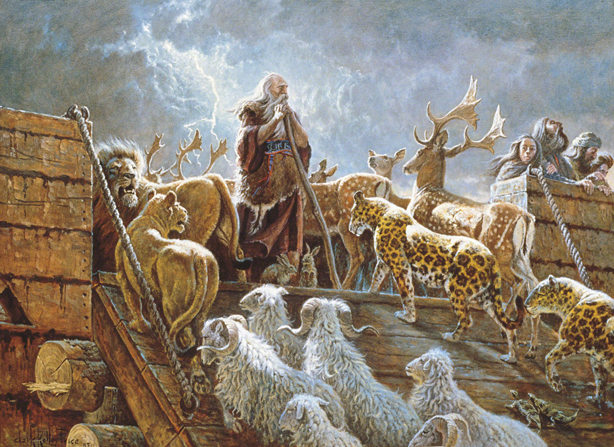
Image result for noah hiding in the ark                Two of the main characters in the Torah, Noah and Moses, have the opposite life trajectory.  The midrash[1] highlights the difference as follows.  Moses is described initially as an Egyptian man.  This is not surprising, of course, given that he grew up in the house of Pharoh.  Nonetheless, it is not a compliment given Egyptian values at the time of both idolatry and enslavement. However, Moses sheds this description over time and by the end of the Torah he is described as a man of G-d[2].  This is a remarkable turnaround and gives us an inkling into what type of internal work Moses did throughout his life.  In contrast, Noah is not so lucky. He starts of as a ‘righteous man’ when we first greet him at the beginning of the parsha but he then becomes a man of the earth after he departs from the ark.  While the ground has some admirable qualities, generally an association with the earth is a sign of an existence overly identified with physicality.  What happened?  It is not entirely clear given that Noah seems to do G-d’s bidding throughout.  

                One commentary explains that the difference between Noah and Moses was in the way they approached their life’s work.[3]  There are people who approach their life as a lonely mission towards personal actualization.  The people around them are a distraction in their achieving personal excellence.  In contrast, there are people that decide to dedicate themselves’ to the well – being of the community.  This comes at a tremendous self-sacrifice as their personal time is cut by all the responsibilities.  This sacrifice is real and can result in diminished wisdom.  However, the purpose of life is the latter according to the midrash. 

                Moses ended his life at a higher level of completion than Noah.  Why? When the nation of Israel faced destruction in the episode of the golden calf, Moses went to bat for them and even told G-d to erase him from the book if Israel is not to be saved. In contrast, Noah didn’t inspire his generation to improve or inspire G-d to save his generation. He went into his own ark and saved himself and his immediate family.  That root of self-centeredness, even though it came with good intentions was his downfall later on in life. Moses, in contrast, had a root of otherness that blossomed throughout his life and led to his greatness. While it may come at a personal cost at times, we have to ask our-self, what are we here for in the end?  If the answer is for the well-being of the community we may find our self paradoxically more elevated.


[1] Midrash Rabbah 36
[2] Devarim 33
[3] Meshech Chochma

Friday, June 8, 2018

Spying out the reality

Image result for challah and wineFriday night Shabbat meals are defined by two important Jewish staples- Challah and wine. It is hard to call it a Shabbat meal without these two minimal requirements. What is interesting, though, is that these two items make entering Shabbat a unique challenge. What is the problem? Shabbat is a celebration of an important fact- G-d created the world.  One way our sources tell us to strengthen that fact is to meditate on all the sweet fruits, vegetables, animals, and vistas on this small, scenic planet.  This brings us to a slight conundrum.  What you won’t find walking around is wine trees or challah trees. Why? Because it takes quite a bit of human ingenuity to make wine and bread.  If so to celebrate Shabbat properly we should take a juicy peach and a thick steak as they seem to be more directly a product of G-d when compared to the wine and bread that required human interference to produce.  So what is the idea?

                Wine and bread represent the two different ways human beings express their creativity in the world. Let’s take wine. Wine is the process in which we unleash the potential inside of a grape. It is a process of taking what is already there and making it better.  Bread is a different type of human ingenuity.   It is a process of taking two different items, flour and water, mixing it with yeast, giving it time, and producing a whole new compound.  

                That is the reason why we start Shabbat with these two items. It is specifically with the two items where it is difficult to see G-d’s hand in it because ours is so prominent that we challenge our self to still thank G-d for it.  Why mention this now?  Because the idea of wine and challah directly follows the sin of the spies to teach us at the heart of the sin was this specific issue. While living in the spiritual richness of the desert, seeing a natural land felt devoid of the divine, almost like going back to Egypt, so they spoke ill of it. They didn’t realize that life is about seeing through nature to see the divine. In a similar vein, we are supposed to see the divine through human ingenuity as we enter into Shabbat, specifically because it is difficult. 

Friday, May 11, 2018

Magic number 613


Image result for 613          The number 613 always struck me as a bit clunky and random.  It didn’t have the beauty of a round number or even an even number, and it never came up during a math class as a quirky number with special qualities.  It seemed to be a strange number to anoint as the Jewish symbol of excellence and spirituality.  So how did the Jewish people end up with 613 special pathways of spiritual connection?[1] The Talmud (Makkos 24a) states, “Rabbi Simlai expounded that 613 mitzvahs were told to Moses at Sinai 365 (negative commandments) likes the days of the sun and 248 (positive commandments) against the number of man’s limbs.”[2] One may be tempted to say that the number is random; that is how many mitzvah’s G-d deemed necessary to put in the Torah. But the Rabbis came along and connected the number to the days of the sun and parts of the body.  The questions then become obvious.  Why are these two aspects of the world singled out and how do they manifest within the context of the mitzvahs?
            Man and the sun represent two disparate aspects of the universe, nature and that which transcends nature.  These in turn mirror both aspects of effective rulership.  The first job of a ruler is to maintain the natural order of a nation, or in other words, establish enforceable laws that will keep the laws of the jungle at bay and establish unity.  The other job of a ruler is to provide the resources necessary to grow the nation into its creative potential. The two groups of mitzvahs that G-d gave us are the means to fulfil these roles effectively as represented by the man and the sun, subsequently enabling man to rule the world properly.
            Let’s start with the sun, which correlates to the 365 negative commandments.  The function of a negative commandment is to ensure that we maintain an order to the world.  That means no killing, no stealing, and no adultery etc..   The sun functions in the same way.  It orders the orbits of our immediate solar system and it maintains a steady path across the sky without waxing and waning like its counterpart the moon. 
            Then there is the human body which correlates with the 248 positive commandments. These Mitzvahs are there to help us transcend the natural order of the world towards a cohesive completion.  Man is called אדם, from the language of אדמה, which means dirt.  The whole idea of dirt is that it gives energy to a seed and helps it develop its potential as a plant.  Man’s job in this world is to excel at this second aspect of rulership and provide a positive development beyond that of the natural order running its course. Man stands at the crossroads of what he can become, and the goal is to fulfil his G-dly potential. Therefore, it is no surprise that in the Torah, the numerical value for b’tzelem Elokim is 248 as found in the verse in Genesis 1:27 ‘So G-d created man in His Image…’.  It is through the 248 mitzvahs man can fulfil his potential tzelem Elokim and complete the world properly.  
            The mystery of 613 is now clear.  The mitzvahs are intended to help human beings establish a basic order in the world by channelling our free will in the proper direction, and then gives human beings the tools to transcend the boundaries of nature and complete the world spiritually.