Friday, June 5, 2020

What we see


Seeing and Being Seen | Insights BlogIn the age of the internet, we now have the ability to see the world all the time.  The question is whether it is healthy to see so much and see everything? There are big expectations to what we see in the world- it is supposed to spur us to action. And according to the mystics, what we see may be a personal message of what we are supposed to fix in our own life.  Regardless, we are not supposed to gloss over what we see in the name of curiosity.  As one Rabbi used to do, he'd read the newspaper with a book of psalms next to him.  From where do we derive this message, and based on what is happening now, where we are seeing a barrage of disturbing videos, how should we react?

              The message is delineated in the strange juxtaposition in this week’s Torah portion by what seem to be unrelated subjects.  First, there is the case of the broken marriage or Sotah.  A husband suspects his wife of adultery based on damning circumstantial evidence, and a complicated ritual is done at the temple to ascertain whether the adulterous act has actually happened.  If innocent the couple comes back to together and a child is born within the year.  Directly after describing this tumultuous event, the Torah then delves into the laws of a nazarite, a person who has decided to become exceptionally pious by refraining from wine, ignoring his physical appearance, and staying away from the deceased.  Why would this exceptionally holy person be juxtaposed to a tabloid worthy scenario of family strife?

              The Talmud asks this question and says that a person who sees the procedure of a sota take place should decide to become a nazarite. Why? Because wine is the type of drink that can lead to adultery. In other words, when we see an act, on the one hand we may be horrified, but on the other, the act now becomes part of normal human behavior and it can seep into our subconscious as a real possibility. Therefore, to ensure that it does not become the new ‘normal’ we need to take an active step against losing our abhorrence of it. More than that, according to Chassidic thought, seeing that scenario was divinely orchestrated because that person needed to work on that specific character trait from the beginning and this was a way of stimulating the person to take action. 

              In light of all we have seen in the past week, from a murderous abuse of power, to looting, these images require actions at the human level. There is insensitivity happening in many directions and we need to be aware of it and make sure that insensitivity doesn’t creep into our hearts, and to do that, we need to run in the other direction. At the very least, we need to increase our empathy and sensitivity to those who are different than us.


Friday, May 22, 2020

Bringing back the lost


The Revelation at Mount Sinai – Gateways OrgPoor Shavuot, it is by and large the least known of our holidays by the extended Jewish people- why? It has a lot stacked against it. For one, it is one day long in contrast to Passover and Sukkot.  But that shouldn’t be damning, as so is Yom Kippur.  However, the other issue is that there is nothing remarkably memorable about the day because there are no actual mitzvot that are specific to Shavuot unlike Yom Kippur which has the funky sneakers and the interminable fast that we dread for months before.  Finally, to add insult to injury, the Torah doesn’t mention it explicitly in the Torah. It talks about it in a most roundabout way, only discussing the technical sacrifices of the day. Why is that? Furthermore, why do the sacrifices of the day fly in direct contrast to what we just experienced on Passover? For a week during Passover and the month when we were cleaning our houses, our sworn enemy was chometz (leavening).  We got rid of it and talked behind its back about how nasty it is. Now, this enemy is granted new life.  It is now extoled and brought to the holy alter as the sacrifice of the day- why the change?

              To unravel the mystery we being with why there are no mitzvot on Shavuout. The reason is because of a verse in proverbs “A mitzvah is a candle, and Torah is like light”.  A candle is a physical object that is able to generate and hold light.  Light is the conceptual raw material that makes a candle possible.  Similarly, a mitzvah is the physical manifestation that generates and expresses a Torah principle.  On Shavuot, we celebrate the receiving of the light, the Torah which is a completely intellectual endeavor- there is nothing to see! For this reason, there are no mitzvot and because it is such a high concept, there is no verse in the Torah that can possibly describe such an abstract and ethereal concept. 

              Furthermore, the verse states, “…you will bring a new offering, from your dwelling place, two loaves of bread…with chametz..”.   It is explained that it is called a new offering as a hint to Torah, which must be constantly renewed each day. Incidentally, that is a second reason the Torah doesn’t want to specify the day.  One shouldn’t think that Torah learning is restricted to Shavuot, it is something that needs to happen constantly. Furthermore, our former enemy is now the hero because of the idea that chometz represents our evil inclination. Unfettered, the evil inclination needs to be cleaned out and not spoken about. However, if provided with a Torah structure, all of a sudden the evil inclination is no longer a hindrance, but something that can be used to enhance all of our service.  Therefore, on Shavuout, we offer the chometz with confidence that we can now control it and make productive use of it.  This is the reason why Shavuot is given short thrift in the Torah. There is not much to say about such a special day. It is a day we take with us the whole year and as long as the Torah stays fresh, it is the greatest tool to bring out our best.

Friday, May 8, 2020

Jewish innovation

Living in the Presence of Divine - Ananda Delhi NCR
Jews are credited with a plethora of creativity in the fields of arts, science, economics- basically any field under the sun. Unfortunately, we are not always credited with our most creative and productive work, sanctifying G-d’s name. What does it means to give sanctity to G-d’s name and why is it our most creative work?

              To begin, we need a working definition of sanctity.  One way of defining sanctity is the ability to do an act purely for its own sake. In other words, our world is bounded and anything in it can at best be exchanged, one thing for another, whether in physics or in our daily interactions. Normal terms of operations between people is if you scratch my back, I’ll scratch yours. Or, at the least, if it isn’t a direct exchange, a person expects something else in return whether it be recognition or a sense of satisfaction. Holiness is realizing that one can get past that natural path and do things in an altruistic way that breaks the cycle of nature and creates a one way street.  Since we are created in the image of G-d, we can act G-dly and give because that is who we are and not because of what we get in return.  To be able to break out of the natural cycle, and create a new way of interacting is the greatest act creativity one can do.

              Not only is it a great thing, but the verse in this week’s Torah portion indicates that this is what we are meant to do! It says, “You shall not profane my holy name, that I may be sanctified in the midst of the Israelite people—I the LORD who sanctify you, I who brought you out of the land of Egypt to be your God, I the LORD.” Why is the first verse followed by the second? Because it indicates that the entire reason for bringing is out of Egypt was so that we could create this new pathway of holiness and by doing so, this shows the world that our ability to subdue nature is a product of the fact that there is a Divine spark in each human being that in itself bespeaks to a Divine presence in the world.  The good news is that this innovation has another result.  If we break out nature, G-d says, I will break nature in return and express sanctity to you in the form of Divine miracles.  We can never rely on this, as this would actually bring us back in to a cycle of doing something for something, but it is something that exists.

              In light of some negative news about the Jewish people and the fact that there have been some small groups among us that find social distancing to be a challenge, a way to fight the negative news is to up our Kiddush Hashem. That has happened via plasma donations and other amazing activities that often goes underreported   And we can continue with a few other things as well. Maimonides points out how to do it. First, invest in Torah and then show exemplary behavior in your actions with small things such as paying workers on time, and maintaining an exceptionally pleasant demeanor among a few others things.  The best defense is a better offense.

Friday, May 1, 2020

What is the key to positive relationships?


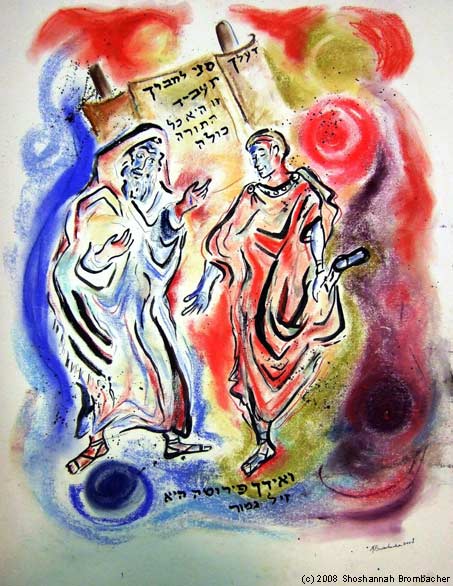
On One Foot - Jewish StoriesThere is a grand debate about which really is the most important principle in the Torah. Most people know the famous story about the convert who came to Hillel and asked to be converted on the condition that he is taught the whole Torah on one foot. Hillel is nonplussed by the seemingly bold request and answers that a person should not do what is hateful to him to another person, that is the entire Torah and rest is just details, now go learn.  He understood the covert was genuine and simply wanted a framework with which to build his knowledge. However, there is a slight problem with the conventional understanding of this story.  It seems the only idea that he teaches the potential convert is that the foundation of Torah is how we treat others, but that may not be the whole picture.

              The Talmud in Makkos deliberates about what are the foundational mitzvoth in the Torah.  If we had to distill 613 mitzvoth to a small number of mitzvoth that represent the others, what would they be? The Talmud concludes that all mitzvoth could be distilled to a verse in the prophet Habakuk: “ A righteous person in his faithulness he shall live”.  Meaning, that all mitzvoth boil down to faith.  We are now left with a question, is the main foundation of Torah faith or how to relate to others?

              The question is a straw man because it is based on a flaw in the way we read Hillel’s statement to the convert.  The reality is that the verse that Hillel’s idea is based on has an ending that is often left off. The full verse is, “Do not bear a grudge or take revenge, and love your neighbor as yourself, I am Hashem.” Therefore, if we understand that Hillel’s communication to the convert is the whole idea of that verse, it includes the idea at the end- “I am Hashem”, which is the foundation of all faith- there is a G-d. Now, Hillel’s statement incorporates both foundations. The Torah is based on having a healthy relationship with others in addition to a healthy relationship with G-d.  This makes sense if we look at the Ten Commandments that are also divided in this fashion, on two tablets, one dedicated to establish a relationship with G-d and another to establish a relationship with man.  It could also be that not only are these two principles the foundation, but it could also be that they are inextricably linked in that the key to success in our relationships with others is to understand that there is a G-d from which we all descend.


Friday, April 24, 2020

What to do in quarantine?


COVID-19 — Coalition to End Social Isolation & LonelinessQuarantine is not a new concept. The idea that there are times when we need to be isolated was clear in ancient times when a person afflicted with a skin disease was told to isolate for at least a week.  The difference is the reason.  While it may look like it is because of a physical condition, the reality is very different (one way we know it isn’t because of a physical condition is because if a person is found to be completely covered with the skin disease, he is considered pure and does not isolate).  When are we quarantined in the Torah? When are people told to stay away from other people for at least a week, and maybe more?

              There is a mysterious set of descriptions that talk about the skin conditions that affect a person. The Torah describes these different skin sores as a ‘s’eis, spachas, or a baheres’ and they can result in a person becoming a ‘metzora’.  More on what these words mean in a second.  After a potential ailment appears, the person is brought to a Cohen to determine if the malady is indeed an official spiritual malady, also know as ‘tzaras’. The question is why does a Cohen specifically determine the condition and not any Rabbinic scholar who has learned the laws like most situations?

               The words above, ‘seis, sapachas, baheres and metzora’ have the following connotation. The word ‘seis’ means to be picked up which hints at arrogance.  The word ‘sapachas’ means an attachment and hints at an attachment to money. Finally, the word ‘bahares’ is related to the word white because one who speaks evilly about somebody else, whitens their face.  Finally, the word metzora is a conjunctive word that means to bring out evil- this person brought evil out to the world and contracted 'tzaras', which is a testimony to the negative way in which he viewed the world. The word 'tzaras' means to have a negative perspective.   

              There are two ways that a person can grow and change from this.  First, we need good role models to show different behavior.  That is why this person goes to a Cohen to be checked.  The model of the Priests was Aaron and he represent the idea of exuding loving kindness to others. This ability flowed through his descendants and the first way to help a person out of his negative paradigm is to give them a new one.  Interacting with a person whose values are the opposite of yours promotes a new persepctive, and seeing it lived is much more powerful than going to a scholar who can only provide information.  The next idea is that a person then has to be alone both to reflect and to avoid damaging more people.  Hopefully, that time of reflection creates change and the Cohen can come back and declare that this person is now different. 

              Given our situation, perhaps, our quarantine can be viewed in much the same way.  There is a preponderance of evil speech, arrogance, and love of money in the world right now and this is a time to reflect about looking beyond superficiality (perhaps that is why the ailments are on the skin) and going to a deeper place about what is truly important.  

Friday, March 20, 2020

Opportunities in illness


Image result for illnessSeveral close friends have gotten the covid-19 virus, and luckily, have emerged relatively unscathed with a minor cold and fever. But what is the function of illness in the world? So it depends which type. One may find it quite surprising that according to Jewish tradition, when it comes to terminal illness, we asked for it! I don’t mean we asked for it as in we had it coming, but quite literally, we asked for it! It says in a midrashic text that Abraham asked for ageing, Isaac for physical weakness, and Yakov for illness before death. In a classic case of finding the positive, the midrash states that illness before death allows for everyone to tie loose ends with ones’ children and to have final conversations.
              What about temporary illness? There is a fascinating insight by Rabbi Nachman that explains one of the benefits of illness.  To summarize, we usually go about life and are often distracted from the big questions such as why do we exist and what is our personal purpose within the world.  After sufficient distractions, the soul says, enough is enough! I need to shake things up. So he weakens the person sufficiently to catch an illness.  During that illness, a person suddenly become very focused on becoming healthy.  Their schedule changes and they are willing to eat healthy and put aside their normal desires to swallow bitter medicines to get better.  The person realizes that they are not controlled by their desires and distractions and if necessary they are able to stay focused on what they need.  Of course, spiritually speaking, knowing our purpose and having meaning in life is not a luxury but a necessity to keep the soul healthy.  The goal is that post recovery, the body remembers that just like it needed a program to stay healthy, the soul does to and not to sabotage its needs. 

              Finally, a third idea comes from the Talmud. It says that a person that visits an ill person shouldn’t sit on the bed with them, and not on a chair next to the bed. Rather, one should wrap himself in awe and sit before the person. Why? Because next to a sick person, there is a divine presence. Whenever we feel fragile and outside of normalcy, our instincts call out to the divine and the divine responds with Her presence. There is no greater synagogue than the one that sits in the Sha’rei Tzedek hospital in Jerusalem. Everyone prays there with sincerity and urgency, which should always be the case.  As we sit at home this Shabbos, against our will, we should recognize the change that has taken place and use it as an opportunity to appreciate our fragility and reach beyond our self.
             

Friday, March 13, 2020

Turning plagues into blessings

Image result for coronavirus
As often happens, the Torah’s weekly reading parallels a current event. Granted, we Jews have a creative knack for finding connections, in this case, there is no need to stretch. The parsha begins with a census. However, in Torah thought, a census is not a straightforward endeavor.  Counting brings with it an immense danger,” with a counting, there is an evil eye that accompanies it, and it is accompanied by a plague” (Rashi).  For this reason, right after the count, Jews are meant to give a half-shekel to atone for this audacious counting.  The question is why is counting fraught with danger? What is an ‘evil eye’ and how is atonement achieved via giving a half shekel? Secondly, how does this information, perhaps, apply to our current situation?


              Counting has several connotations. It puts the spotlight on one individual and, in a sense, isolates them from the community as it points out that this person is a single, important, and visible number. These are great things in many ways, but  brings with it three problems. First, it highlights the person as an individual with all of his foibles and flaws.  When in a group, a person can rely on his strength and count on others to make up for his weaknesses, which is why the Torah views groups as meritorious.  For example, a short basketball player will not be docked for being a poor rebounder because on his team he likely doesn’t have to.  But if we were to look at him as an individual basketball player, we’d notice that he is not a great rebounder.

  Second, it creates overexposure as a person who is singled out can’t hide within the group.   The problem with overexposure is that when we really see something, we may be tempted to say ‘I’ve seen the whole person’, which is of course impossible.  Whenever we see a person, it is always just the tip of the iceberg.  A person is complex with a myriad of hidden thoughts and experiences.  When judging just what we see, it can create a false and negative impression.  Mr. Rogers says it best, “what’s essential is invisible to the eye…Particularly when we don’t slow down and really look”.

  Finally, it creates an evil eye in that too much importance given to somebody generates jealousies, and begs the question does this person really deserve this much status? We end up judging a person harshly (incorrectly) based on what we see. This in turn creates a spiritual danger for that person as our judgements also create spiritual judgements which in turn can create a plague. To summarize: counting has the potential to create an individualistic society, a shallow society, and a jealous society focused on status all of which create a society ripe for a plague.

Why a plague? Because a plague accomplishes a remedy to these three issues. A plague reminds us that we are part of one big community. A sneeze in China can affect an American in New York- we are never truly individuals.  Next, we are forced to go into hiding and not overly expose our self and every aspect of our life (granted, with facebook there is no real thing as indoors, but there is less content to show).  It also forces us to slow down and really take people in properly so that we can begin to understand them.  Finally, viruses are equal opportunity invaders that can affect the prince or the pauper, the celebrity and the laborer.

              However, we avoid the forced fix with a positive fix- the half-shekel donation.  Through the donation, a person reunites with community via a community project and by giving half, they realize they are not complete without the rest of the community. Furthermore, both the rich and poor gave the same donation-everyone is equal and no one is more visible than anyone else.

So what we can we do with our current predicament without the potential for a half-shekel donation? We can take the ideas of a half- shekel and apply it our world. Let’s work on creating community. Let’s work on our depth and treat others as complex beings whom we can’t judge or understand based on first appearances. Let’s slow down and take people in properly.  Let’s not concern our self with our own status or anyone else’s- we are all in the same boat. If we do this, we can transform this virus from a plague to a blessing.